
1.1 — Christian Ethics: The Individual and Responsibility
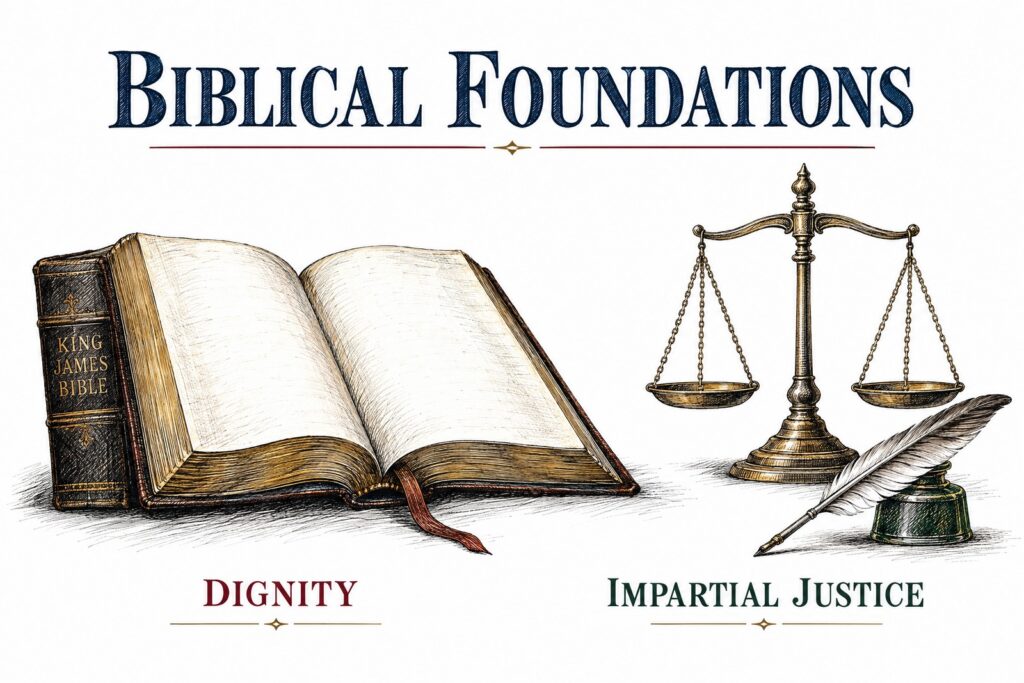
Liberty begins with the individual. The Scriptures describe human beings as created in the image of God and call for righteous judgment and fair treatment of others. These teachings place moral responsibility alongside the exercise of freedom—a relationship that RTR returns to when discussing accountability.
The Individual in Creation
Genesis 1:27, KJV [source link placeholder] states:
“So God created man in his own image, in the image of God created he him; male and female created he them.”
— Genesis 1:27, KJV
This account places the individual in a relationship with the Creator.
The Declaration of Independence
(1776) [source link placeholder] would later describe all men as created equal and “endowed by their Creator with certain unalienable Rights.”
The biblical passage concerns creation; the Declaration states principles for political independence and government.
Together they introduce the relation of the Creator, the individual, and rights.
Impartial Judgment and Treatment of Others
Leviticus 19:15, KJV [source link placeholder] states:
“Ye shall do no unrighteousness in judgment: thou shalt not respect the person of the poor, nor
honour the person of the mighty: but in righteousness shalt thou judge thy neighbour.”
— Leviticus 19:15, KJV
The command makes righteous judgment a duty: neither poverty nor power is to determine how a person is judged. It directs the person exercising judgment to a standard beyond personal preference or the standing of the parties.
Jesus states a related rule of conduct in Matthew 7:12, KJV [source link placeholder]:
“Therefore all things whatsoever ye would that men should do to you, do ye even so to them: for this is the law and the prophets.”
— Matthew 7:12, KJV
The command joins consideration of one’s own treatment to the treatment one gives others.
Freedom of action therefore sits beside a duty to exercise that freedom responsibly.
Liberty and accountability.
RTR Episode 250324 describes liberty as more than the freedom to choose. “Liberty isn’t just freedom to choose,” the episode explains; liberty also involves responsibility and accountability for the consequences of choices. It relates that accountability to the Christian understanding of answering to God.
The exposition gives the moral duties just read a direct bearing on the use of liberty.
RTR Episode 250324 — 19:08–19:56 — audio excerpt link placeholder
The same concern follows authority into civil society: when a person or institution exercises power, the manner in which that power is used matters.
The written records that follow ask how law and people may hold that exercise of power to its bounds.
1.2 — Magna Carta: written limits and redress, 1215
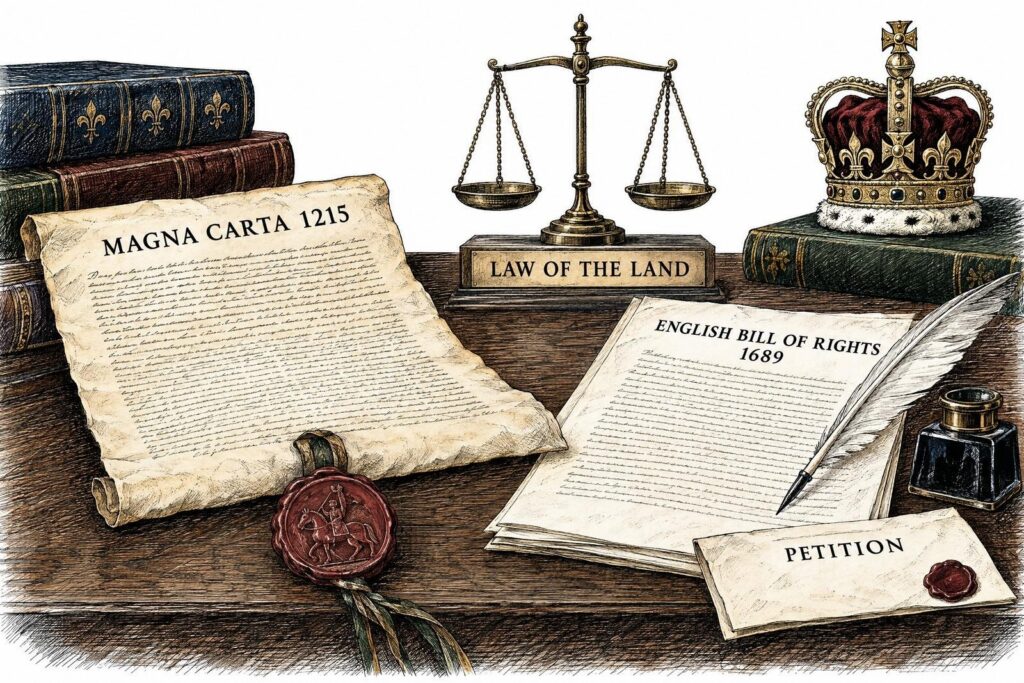
In 1215 King John faced a quarrel with his barons over the terms on which the kingdom was governed. The resulting charter addressed scutage and other feudal obligations, liberties of the Church, property, and the administration of justice. Given at Runnymede, Magna Carta (1215) [source link placeholder] put the king’s concessions into writing and set out a means of seeking redress when its terms were broken.
The charter also addressed how certain payments could be imposed. Clause 12 required common counsel before scutage or aid could be levied, subject to specified exceptions; clause 14 described whom the king would summon for that counsel. Matters of payment and consent thus appeared among the charter’s written terms.
Lawful judgment
Clause 39 of Magna Carta limits the king’s actions against a freeman:
“No freemen shall be taken or imprisoned or disseised or exiled or in any way destroyed, nor will we go upon him nor send upon him, except by the lawful judgment of his peers or by the law of the land.”
Clause 40 adds:
“To no one will we sell, to no one will we refuse or delay, right or justice.”
These promises place judgment and justice against a standard other than the ruler’s unchecked will. Clause 39 speaks of “freemen”; its precise terms belong to the charter’s own time. In the later Bill of Rights (1791) [source link placeholder], the Fifth Amendment uses the words “due process of law” to protect against deprivation of life, liberty, or property.
A written process for a broken undertaking
Clause 61 addresses the practical question of what happens when the king or one of his officers breaks the charter. The barons are to choose twenty-five of their number to observe and cause the charter’s peace and liberties to be observed. A reported breach goes to four of them, who are to lay it before the king—or his justiciar when he is outside the realm—and petition for redress. If the breach is not corrected within forty days, those four refer it to the rest of the twenty-five.
RTR Episode 260102 — 09:18–10:58 — audio excerpt link placeholder
The clause then describes measures against the king’s castles, lands, and possessions until redress is obtained, while protecting the persons of the king, queen, and children. After redress, the previous relationship is to resume. RTR Episode 260102 contrasts the king’s grant in a charter with an agreement between parties, reads the provision, and emphasizes that the promise included a process for bringing a breach forward and seeking a remedy.
RTR Episode 260102 — 12:57–14:20 — audio excerpt link placeholder
The charter’s procedure was a medieval arrangement between a king and his barons, not the procedure established by the later American Constitution. Its enduring question remains clear: how are written limits made meaningful when those exercising power fail to observe them?
1.3 — The English Bill of Rights: law and petition, 1689
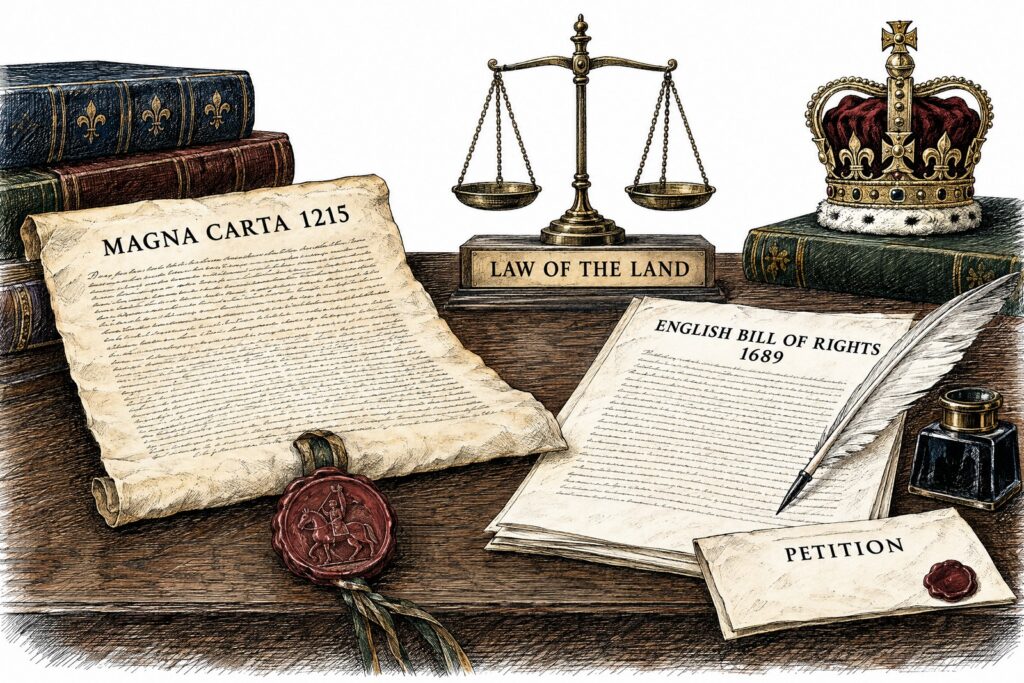
More than four centuries later, another English crisis brought royal authority and the rights of subjects into focus. The English Bill of Rights (1689) [source link placeholder] charges James II with suspending laws without Parliament’s consent, raising money and maintaining a standing army contrary to the stated legal limits, and prosecuting prelates for petitioning. It records the throne as vacant following James’s abdication and recounts a declaration presented to William and Mary. The grievances explain the force of the document’s declarations of rights.
“That the pretended power of suspending the laws or the execution of laws by regal authority without consent of Parliament is illegal;”
“That it is the right of the subjects to petition the king, and all commitments and prosecutions for such petitioning are illegal;”
The first declaration rejects a claimed royal power to suspend laws without Parliament’s consent. The second protects a means of making a grievance known: subjects may petition the king without being imprisoned or prosecuted for petitioning. The document also declares protections concerning taxation, standing armies, elections, juries, and punishments.
RTR Episode 260102 reads the petition provision and connects the act of seeking redress with people’s ability to communicate and assemble. Petitioning puts a grievance before authority; organizing and speaking with others make it possible to identify and present that grievance together.
RTR Episode 260102 — 29:48–30:14 — audio excerpt link placeholder
A century later, the First Amendment to the Bill of Rights (1791) [source link placeholder] uses its own terms: Congress shall make no law abridging “the right of the people peaceably to assemble, and to petition the Government for a redress of grievances.” The English declaration speaks of subjects petitioning a king; the First Amendment protects the people’s petition to their government.
1.4 — Locke: rights, duties, and the purpose of civil government
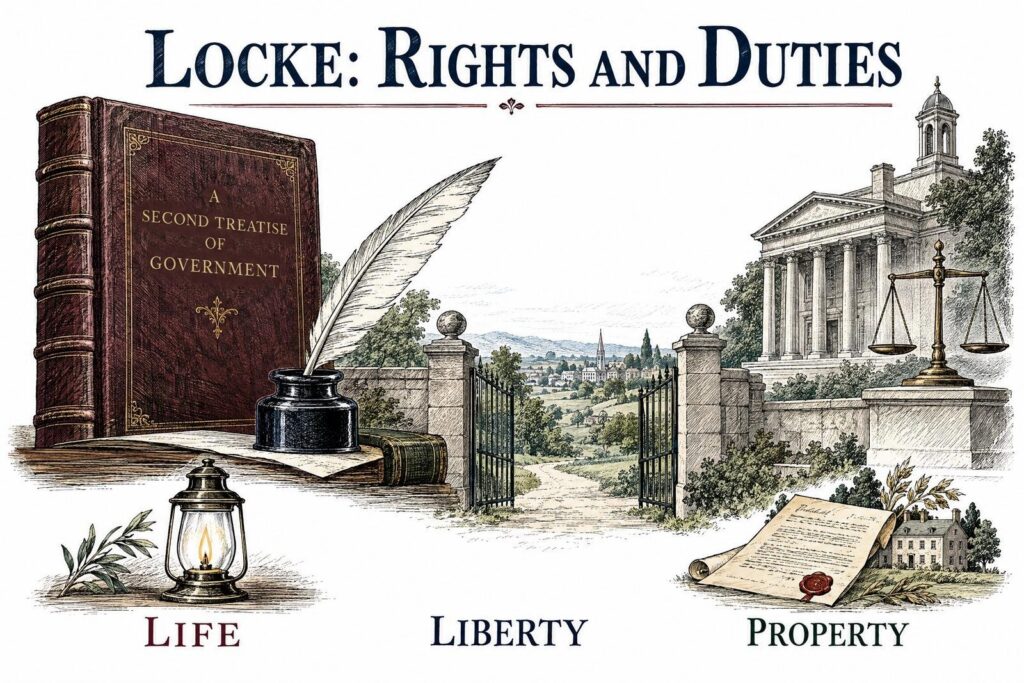
Why would free and equal individuals enter civil society, and how should the power they create be exercised? Writing before American independence, John Locke addressed those questions by joining natural rights to duties toward others and by asking what kind of law and judgment can better protect liberty and property.
Equality and duties toward others
In Second Treatise of Government, §6 [source link placeholder], Locke describes human beings as equal and independent and writes that:
“no one ought to harm another in his life, health, liberty or possessions”
Locke grounds this duty in his account of human beings as the workmanship of one Maker. He also says that each person, when his own preservation does not compete, ought as much as possible to preserve the rest of mankind. Liberty in his account is not a license to injure another’s life, health, liberty, or possessions.
Known laws and impartial judges
In §131 Locke explains that people enter society to better preserve themselves, their liberty, and property. He says the legislature’s power is directed to the common good and that government is bound to use:
“established standing laws, promulgated and known to the people, and not by extemporary decrees”
Locke adds that “indifferent and upright judges” should decide controversies by those laws. Here indifferent means impartial. The law should be known to the people and applied by judges who decide according to it rather than by an improvised decree.
RTR Episode 250324 likewise places responsibility and accountability beside freedom of choice. Locke’s account and the RTR exposition use different words, but both ask what the freedom of one person requires in relation to others.
The Declaration of Independence (1776) [source link placeholder] would state that governments are instituted to secure rights. Locke’s account of known laws and impartial judges points toward the later American concern with a government whose authority and limits are set out in writing.
1.5 — The colonies: representation, grievances, and consent
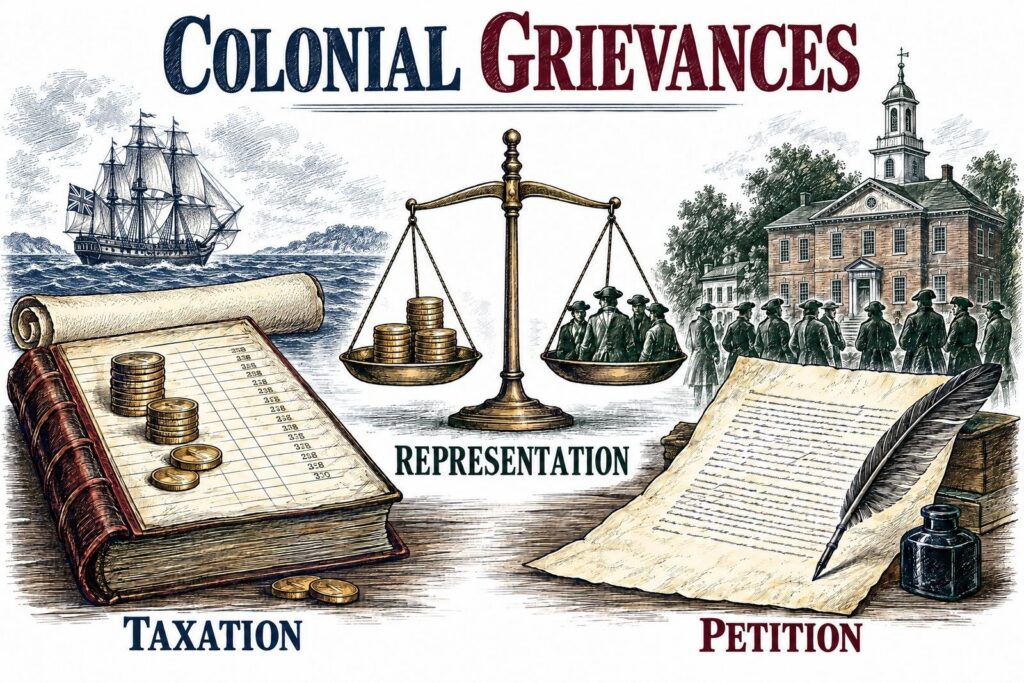
By 1774, disputes over revenue, courts, military presence, and the powers of colonial assemblies had sharpened the rift with Britain. The Declaration and Resolves of the First Continental Congress (1774) [source link placeholder] records these grievances and says that petitions to the Crown had repeatedly been treated with contempt by its ministers. Colonial deputies gathered in Philadelphia to assert rights and seek their protection.
The First Continental Congress, 1774
The resolves describe parliamentary taxes and duties imposed on the colonies, an extended admiralty jurisdiction, judges dependent on the Crown for their salaries, and standing armies in peacetime. They also protest the closing of Boston’s port, changes to the government of Massachusetts, and the dissolution of assemblies when they sought to deliberate on grievances.
Before listing the rights it claimed, Congress invoked:
“the immutable laws of nature, the principles of the English constitution, and the several charters or compacts”
In its fourth resolve, Congress stated:
“the foundation of English liberty, and of all free government, is a right in the people to participate in their legislative council”
Congress maintained that the colonies were not represented in Parliament and asserted a role for their provincial legislatures in taxation and internal affairs. The same resolve expressed consent to certain acts regulating external commerce. Its argument joined the right to participate in government to the location and limits of legislative authority.
Petition and independence
RTR Episode 250411 reads a 1774 petition to King George seeking redress and relief from grievances associated with revenue statutes, admiralty courts, trials in Britain for acts alleged in America, and changes affecting Massachusetts and Quebec. The petition’s stated hope was that removal of the disputed system would restore harmony between Britain and the colonies.
RTR Episode 250411 — 44:53–46:27 — audio excerpt link placeholder
By 1776, the Declaration of Independence (1776) [source link placeholder] recounted repeated petitions for redress and a succession of injuries. It declared “that all men are created equal,” that they are “endowed by their Creator with certain unalienable Rights,” and that among these are “Life, Liberty and the pursuit of Happiness.” Governments, it continued, are instituted to secure these rights and derive “their just powers from the consent of the governed.”
The Declaration announced that the united colonies “are, and of Right ought to be Free and Independent States.” The sequence from 1774 to 1776 runs from asserted rights and representation, through grievances and petition, to a declaration of independence grounded in rights and consent.
The Constitution of the United States [source link placeholder], Article VII, later provided for establishment of the Constitution “between the States so ratifying the Same” through the ratification of conventions in nine states. Article I, §1, vests the legislative powers “herein granted” in Congress. These words locate both an act of ratification and a grant of legislative authority in the written instrument.
RTR Episode 260102 presents the Constitution as a compact between the states that created a federal government of delegated powers, and describes the states’ role in constitutional compliance. That exposition carries the questions of consent, representation, and enforceable limits forward into the study of ratification and the constitutional framework.
RTR Episode 260102 — 53:42–54:26 — audio excerpt link placeholder
1.6 — Madison: conscience and the limits of delegated authority, 1785
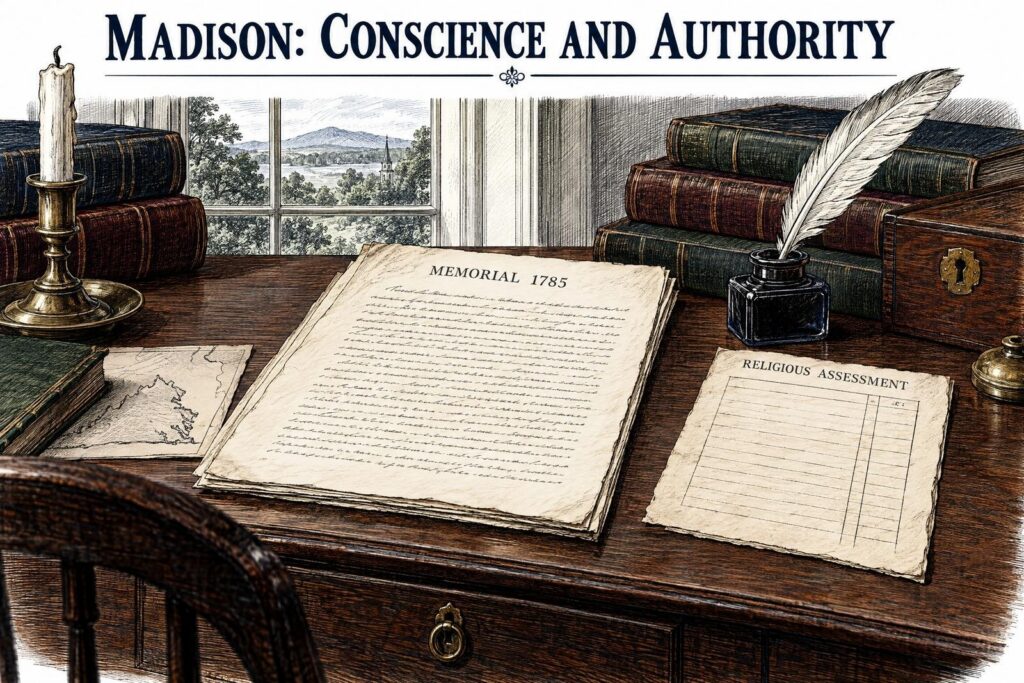
After independence, Americans continued to debate the proper limits of government within their own states. In 1785 a Virginia bill proposed public provision for teachers of the Christian religion. James Madison’s Memorial and Remonstrance against Religious Assessments (1785) [source link placeholder] opposed the bill, connecting conscience and duty to the Creator with the question of what authority a legislature may exercise.
Duty to the Creator and liberty of conscience
The memorial was addressed to Virginia’s General Assembly on behalf of citizens who objected to the proposed assessment. Its first argument quotes the Virginia Declaration of Rights (1776), article 16 [source link placeholder]: religion, or the duty owed to the Creator and the manner of discharging it, “can be directed only by reason and conviction, not by force or violence.”
Madison calls the exercise of religion according to conviction and conscience an unalienable right. He explains why: in his account, what is a right in relation to other people is also a duty toward the Creator, a duty that precedes the claims of civil society.
In §11, Madison invokes “that Christian forbearance, love and charity” when discussing relations among religious sects. His memorial brings Christian conviction and moral duty into an argument about the limits of civil power over conscience.
Derivative and limited jurisdiction
In §2, Madison calls the legislature a creature and representative of society and states:
“Their jurisdiction is both derivative and limited”
Derivative means received from another source rather than self-created; limited means having boundaries. Madison says the powers of the departments must remain within their respective bounds and must not cross the “great Barrier” defending the rights of the people. In §3 he calls “prudent jealousy” toward experiments on liberty a duty of citizens.
RTR Episode 250324 reads Madison’s account of conscience and the legislature’s derivative and limited jurisdiction. The exposition presents the memorial as an argument for religious freedom and draws attention to the source and boundaries of authority.
RTR Episode 250324 — 27:36–31:28 — audio excerpt link placeholder
The memorial addressed a Virginia proposal before the Constitutional Convention. The First Amendment later declared that Congress shall make no law respecting an establishment of religion, or prohibiting its free exercise. The Bill of Rights (1791) [source link placeholder] also states in the Tenth Amendment that powers not delegated to the United States by the Constitution, nor prohibited by it to the states, are reserved to the states respectively, or to the people.
Lesson summary: the sequence of ideas and events
These sources bring related questions into view across different times and governments:
- Moral responsibility: Scripture addresses creation, righteous judgment, and treatment of others; RTR Episode 250324 connects liberty with choice, responsibility, and accountability.
- Written limits and redress: Magna Carta sets limits and a procedure for a reported breach; the English Bill of Rights declares limits on royal power and the right to petition.
- Rights and civil society: Locke joins natural equality and duties toward others to known laws and impartial judges.
- Representation, consent, and the compact: The 1774 Congress connects free government with participation in legislative councils; the 1776 Declaration grounds just powers in consent. Article VII provides for establishment between ratifying states, and RTR describes the Constitution as a compact creating a federal government of delegated powers.
- Conscience and delegated authority: Madison’s 1785 memorial connects duty to the Creator with the people’s rights and the derivative, limited jurisdiction of their legislature.
The next lesson takes up the colonial break and Declaration in greater detail, followed by the union under the Articles of Confederation and the circumstances leading to the Constitutional Convention.
Sources used in this lesson
- Scripture: Genesis 1:27, KJV [source link placeholder]; Leviticus 19:15, KJV [source link placeholder]; Matthew 7:12, KJV [source link placeholder].
- Magna Carta (1215) [source link placeholder], clauses 12, 39, 40, 61 and 63; English Bill of Rights (1689) [source link placeholder], preamble and declarations.
- Second Treatise of Government [source link placeholder], John Locke, §§6 and 131 (supplied PDF pages 107 and 161).
- Declaration and Resolves of the First Continental Congress (1774) [source link placeholder], preamble and resolve 4; Declaration of Independence (1776) [source link placeholder], National Archives transcription.
- Memorial and Remonstrance against Religious Assessments (1785) [source link placeholder], James Madison, §§1–3 and 11, including its quotation of the Virginia Declaration of Rights, article 16.
- Constitution of the United States [source link placeholder], Article I, §1 and Article VII; Bill of Rights (1791) [source link placeholder], Amendments I, V and X; National Archives transcriptions.
- RTR Episodes 250324, 250411 and 260102; approximate source-recording times appear at the audio placeholders.